Taking a Taxi in Beijing: Practical Mandarin, Apps, and What to Actually Expect
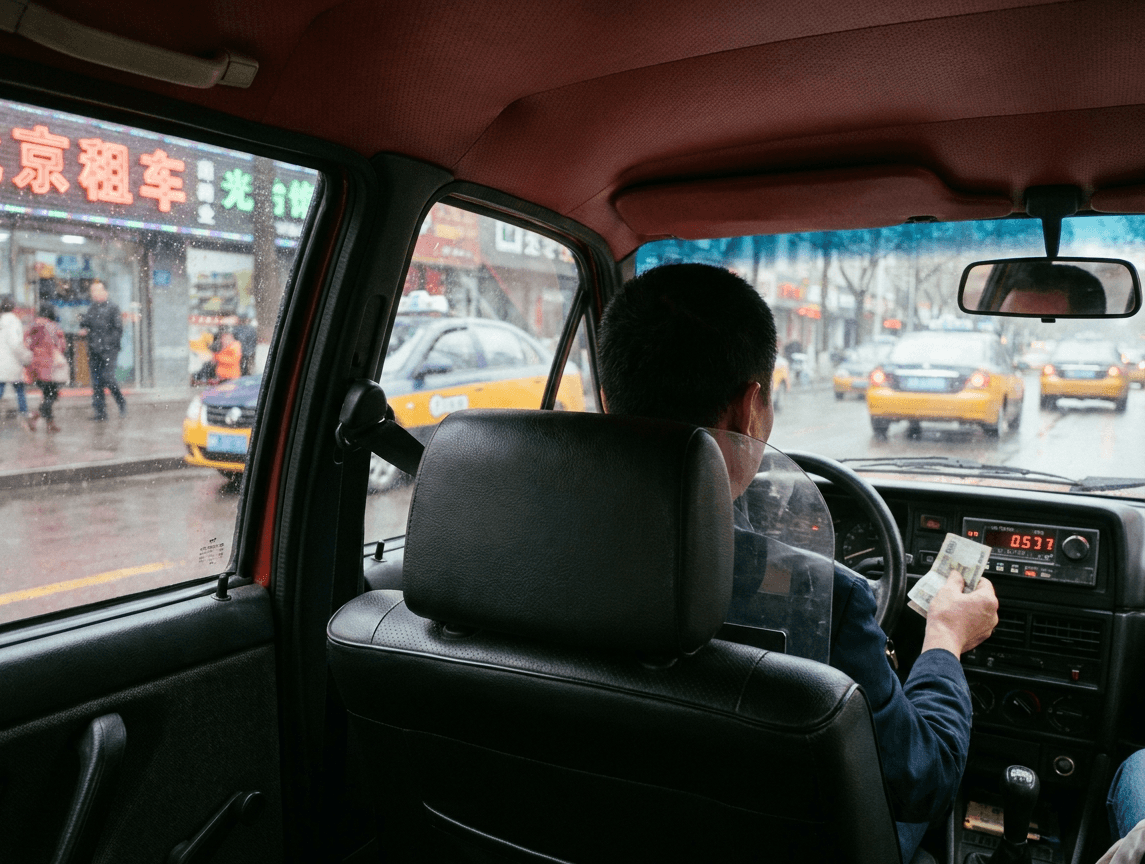
A typical first-time visitor to Beijing can spend 20 minutes trying to explain a hotel name to a taxi driver, in English, then slowly, then louder. The driver wasn't being difficult. He genuinely couldn't parse a foreign name with no visual reference. She eventually showed him a map screenshot. They got there. The next day she had the hotel's Chinese characters saved to her camera roll and the whole thing took ten seconds.
Beijing taxis are metered, licensed, and cheap by international standards, ¥13 flag fall for the first 3 kilometres, ¥2.3 per kilometre after that, most journeys within the 4th Ring Road landing between ¥20 and ¥50. The system works. The complication is almost entirely about communication, not the service itself.
The Address Problem, How to Solve It Before You Land
Most Beijing taxi drivers speak little or no English. What they can read instantly: Chinese characters. Not pinyin romanisation, actual 汉字. A screenshot of your destination in Chinese, saved offline before you need it, solves the problem completely regardless of your data connection.
Google Translate and Baidu Translate can produce written Chinese from an English address, but accuracy varies on street-level detail. Better sources: your hotel's Chinese-language website, the venue's own WeChat page, or asking your hotel reception to write it down. Get it before you leave the hotel, not when you're standing on the street trying to explain.
Six Phrases That Cover Most Situations
我要去… (Wǒ yào qù…), "I want to go to…" Show the address immediately after.
走高速吗?(Zǒu gāosù ma?), "Are you taking the expressway?" Relevant because toll costs sit on top of the meter and can significantly increase the fare on longer routes.
不走高速 (Bù zǒu gāosù), "Don't take the expressway." Use this if you'd rather avoid the toll addition.
多少钱?(Duōshao qián?), "How much?" Mostly rhetorical in a metered taxi, but useful to know.
在这儿停 (Zài zhèr tíng), "Stop here."
收据 (Shōujù), "Receipt." Ask for this if you need it for expenses, or if you leave something in the cab. The receipt has the driver's ID and car number, which is how lost property gets traced.
Didi: The Option Most Visitors End Up Using
Didi is China's dominant ride-hail platform. The app supports English, has a translation feature for driver communication, and takes English destination input, it converts and transmits to the driver automatically. For airports, stations, and tourist destinations, it removes the address problem entirely.
The catch: registering Didi with an international number works, but the SMS verification step occasionally fails on certain networks. Set up the account before you land. If the international number process fails, some hotels will help guests register at the front desk.
Didi Express typically runs 10–20% cheaper than street taxis for equivalent routes. It's not always faster, airport pickup zones can be chaotic, but it's lower-friction for anyone without prepared Chinese addresses.
NOTE: If a driver tells you the meter is broken, get out and take the next taxi. It is never actually broken. Unlicensed "black car" operators (黑车, hēichē) also approach travellers at train stations and airports, they look like regular cars and charge by negotiation. Decline, use the official queue.
Airport Fares: What Adds to the Meter
Two surcharges sit on top of the base rate. A ¥1 fuel surcharge applies to any trip over 3 kilometres. Beyond 15 kilometres, the per-kilometre rate rises from ¥2.3 to ¥3.45, about 50% above the standard daytime rate. Both apply on airport runs.
From Beijing Capital Airport (PEK), around 30 kilometres from the centre, a metered taxi runs ¥100–150 and takes 40–60 minutes in normal traffic. From Daxing Airport (PKX), around 50 kilometres south, expect ¥180–250 including roughly ¥10 in tolls, and 60–90 minutes. Night trips between 23:00 and 05:00 cost around 20% more. Didi fares from Daxing can start from around ¥180, lower than the metered taxi range, though surge pricing applies at peak times.
At both airports, use the designated taxi queues at the arrivals level. Not the drivers who approach you in the hall.
Cash is still accepted everywhere but many drivers now prefer WeChat Pay or Alipay. Keep ¥100–200 in small notes for the ones who don't. The combination of saved Chinese-character addresses and Didi covers 90% of situations. Everything else is preparation, not fluency.