



 Русский
  English (UK)
  العربية
  日本語
日本語  한국어
한국어  Magyar
  Türkçe
  Español
  Čeština
  Svenska
  Português
  Ελληνικά
  Suomi
Suomi  Nederlands
  Română
  Italiano
  Français
  Polski
  Українська
  Deutsch
  简体中文
简体中文  Slovenčina

In August 2025, the Legal Team of GetTransfer.com initiated a formal request for regulatory clarification from the Ministry of Sea, Transport and Infrastructure of the Republic of Croatia (MMPI) regarding licensing obligations for digital platforms enabling pre-booked passenger transport services. The request was part of the company’s ongoing assessment of the feasibility of launching a new intermediary-model platform, “WelcomeRides,” in Croatia and across other EU jurisdictions.
Because EU case law sharply distinguishes between active platform-based models и, конечно же, neutral marketplace models, the central question concerned whether platforms facilitating pre-booked transfers must obtain a Croatian taxi operator license, even when all transport is performed by locally licensed drivers.
Запрос от юридического отдела GetTransfer:
“GetTransfer, a company registered in Cyprus, which is currently assessing the feasibility of launching a new online platform model under the working name “WelcomeRides,” offering pre-booked passenger transport services in Croatia and other EU countries.
Our company is committed to full compliance with all applicable national and European regulations and seeks to ensure that our business model is aligned with both Croatian passenger transport legislation and EU law. The platform we intend to launch will serve as an intermediary between customers and licensed local drivers, enabling passengers to pre-book transfers at fixed fares.
Мы понимаем, что:
1. According to the jurisprudence of the Court of Justice of the European Union, in particular Дело C-434/15 (Asociación Profesional Élite Taxi против Uber Systems Spain SL), Цифровые платформы, оказывающие решающее влияние на основные элементы транспортной услуги, такие как установление цен, определение договорных условий и назначение водителей, должны рассматриваться как поставщики транспортных услуг. Таким образом, на эти платформы распространяются национальные требования лицензирования и регулирования, регулирующие пассажирские перевозки.
2. In Case C-320/16 (Uber France SAS против Nabil Bensalem), Суд далее подтвердил, что если цифровая платформа контролирует операционные условия и предоставление услуг, она не может быть классифицирована как нейтральный посредник в соответствии с законодательством ЕС, а должна соблюдать правила государств-членов, применимые к поставщикам транспортных услуг.
3. Furthermore, passenger transport services are expressly excluded from the scope of the Директива 2000/31/EC об электронной коммерции, то есть цифровые платформы, предлагающие такие услуги, не имеют права на ограниченную ответственность и нормативные исключения, предоставляемые “услугам информационного общества”. Вместо этого регулирование этих услуг входит в компетенцию каждого государства-члена, в соответствии с Директива 2006/123/EC об услугах на внутреннем рынке, что позволяет национальным властям устанавливать стандарты лицензирования, безопасности и эксплуатации для организаций, предоставляющих транспортные услуги на своей территории.
Для дальнейшей иллюстрации нашего запроса и обеспечения полной ясности, мы подготовили две схемы, сравнивающие две различные бизнес-модели, относящиеся к сектору цифрового транспорта. Эти модели широко используются в Европе и принципиально различаются с точки зрения юридических и налоговых обязательств:
Схема 1. Платформенная модель (по аналогии с Uber)
(Пассажир не видит название поставщика до бронирования)
В данной модели:
- Платформа устанавливает тариф по своему усмотрению.
- Пассажир получает только одно предложение напрямую от платформы.
- Платформа заключает договор перевозки с пассажиром.
- После оплаты платформа назначает водителя или поставщика.
Данная структура предполагает, что платформа действует не как нейтральный посредник, а скорее как поставщик транспортных услуг, основываясь на критериях, установленных Судом Европейского союза (например, дело C-434/15 Uber Spain и дело C-695/20 Fenix International). Соответственно, такая платформа может нести ответственность за НДС со всей стоимости проезда, а также за обязательства по лицензированию и социальному обеспечению согласно национальному законодательству.
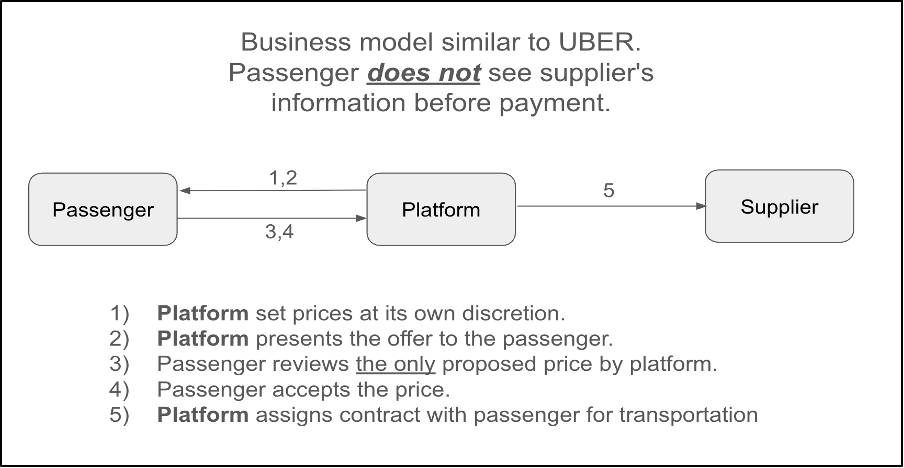
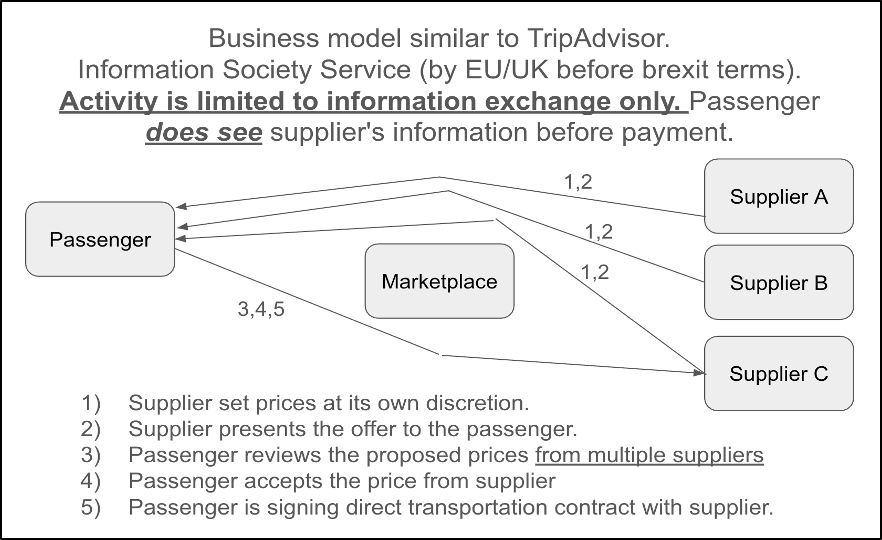
Схема 2. Модель маркетплейса (как TripAdvisor или GetTransfer)
(Пассажир видит поставщиков и выбирает из нескольких предложений)
В данной модели:
- Поставщики устанавливают цены самостоятельно и представляют предложения через платформу.
- Пассажир выбирает среди нескольких поставщиков и видит их идентификационные данные до бронирования.
- Договор перевозки заключается непосредственно между пассажиром и выбранным поставщиком.
- Роль платформы ограничена обменом информацией и содействием коммуникации и оплате.
Эта модель соответствует концепции сервиса информационного общества, как это определено в законодательстве ЕС, и платформы, работающие таким образом, как правило, несут ответственность по НДС только за свою комиссию, а не за полную стоимость проезда, и не считаются поставщиками транспортных услуг.
At the same time, We are aware that many digital platforms are currently active in Croatia. Based on publicly available information, these platforms operate as Scheme 1 and under a unified commercial brand, display fixed prices for common routes, automatically assign licensed local drivers, collect payments directly from passengers, and maintain full control over pricing, customer contact, service standards, and driver allocation. As far as we can determine, these platforms do not appear to hold Croatian transport operator licenses, yet they provide services in cities such as Zagreb.
In this context, and prior to any activity in Croatia, we respectfully request confirmation and legal clarification on the following matter.
We respectfully request your clarification as to whether operating under the Scheme 1 model (“Platform – Based Model”) would require our company to obtain a Croatian transport license, even if all rides are carried out exclusively by locally licensed drivers. Or we can operate the same way as suggested examples currently operate.
Lastly, given that some companies are operating in Croatia using the first model Scheme 1 as described, we would appreciate your confirmation as to whether our company, adopting a similar structure, would be considered in full compliance with Croatian regulatory requirements and lawfully permitted to operate.
We thank you in advance for your time and attention to this matter. We would greatly appreciate your written confirmation or guidance, as this will help us ensure our business model is fully compliant with applicable regulations before launch.”
Мы получили официальное объяснение.:
“Your letter (received by e-mail): August 21, 2025
Контактный e-mail: info@mmpi.hr
Dear Sir/Madam,
The performance of taxi services is regulated by the Road Transport Act (Official Gazette Nos. 41/18, 98/19, 30/21, 89/21, 114/22, and 136/24; hereinafter: the Act).
Article 14, paragraph 1 of the Act prescribes the following:
“(1) A legal or natural person – sole trader may engage in the activity of public road transport of passengers or goods in domestic road traffic if they are registered in the court or trade register for carrying out road transport activities and if they hold a license for domestic transport issued by the competent administrative authority according to the registered office/residence of the carrier.”
Article 47, paragraph 1 of the Act prescribes the following:
“(1) Taxi passenger transport in domestic road traffic shall be carried out on the basis of a license for taxi passenger transport and a permit for taxi passenger transport, in accordance with the definition in Article 4, paragraph 1, item 1 of this Act.”
Article 47, paragraph 4 prescribes:
“The permit referred to in paragraph 1 of this Article shall be issued to a legal or natural person – sole trader who holds a valid license for performing taxi transport in domestic road traffic at the time of submitting the application for the issuance of the permit.”
In order for someone to be considered a taxi operator and to be able to perform taxi transport, they must hold a valid license and a valid permit for taxi passenger transport.
With regard to the use of a taximeter or an application, Article 48, paragraphs 2, 3, and 4 of the Act further prescribe the following:
“(2) If the carrier provides taxi services using a taximeter, the taximeter must be switched on while the service is being provided, and a price list must be displayed in a visible place in the vehicle.
(3) The taxi price list referred to in paragraph 2 of this Article shall be determined independently by the carrier and must contain at least the price per kilometer traveled.
(4) If the carrier provides taxi services through an electronic application in which the maximum price and the planned route of travel are visible to the passenger in advance, the application must be switched on in the vehicle for the entire duration of the service.”
The Act does not differentiate between the “type” of taxi service depending on whether it is carried out via a taximeter or an electronic application. It is always taxi transport, which may be carried out using, in one case, one “tool” (taximeter), and in the other case, another “tool” (electronic application). Likewise, the Act does not differentiate between carriers who advertise via a website or in another way. All who perform taxi transport must meet the prescribed conditions – from the manner of performing this type of transport in accordance with the statutory definition, to holding a valid license and permit, and fulfilling the special vehicle conditions prescribed by the accompanying Regulation.
Article 96, paragraph 1 of the Act defines agency activities and prescribes:
“Agency activities in road transport, within the meaning of this Act, are mediation services in the employment of carriers’ transport capacities in passenger and freight transport on behalf of and for the account of carriers, as well as the sale of tickets on behalf of and for the account of carriers in public scheduled bus passenger transport at organized points of sale, if not carried out by a bus terminal, and obtaining permits for exceptional transports and organizing escorts for exceptional transports within the territory of the Republic of Croatia.”
From the above it follows that agency activities are performed only by legal persons or sole traders who:
- Employ transport capacities on behalf of and for the account of carriers, and
- Issue invoices on behalf of and for the account of carriers.
Companies that act as information society service providers and do not provide transport services, do not employ carriers (carriers are persons who hold a valid license), nor do they conclude transport contracts with them, do not perform agency activities. Instead, they offer a platform through which transport service providers – carriers – establish contact with their users. Should they perform activities corresponding to the cited definition of the Act, they would then be obliged to obtain a license.”
Заключение
The exchange between the Юридическая команда GetTransfer.com and the Ministry of Sea, Transport and Infrastructure of Croatia provides essential clarity for any company evaluating the launch of a digital ride-booking platform in the Croatian market. Croatia’s interpretation of EU case law and national transport legislation confirms a clear distinction between platform-based transport providers и, конечно же, neutral intermediary marketplace models. Platforms that set fares, assign drivers, or contract with passengers in their own name are considered transport operators and must obtain a Croatian licence. By contrast, digital intermediaries that simply connect users with licensed Croatian carriers may operate legally without entering the regulated sphere of taxi transport, provided they do not control the essential elements of the service.
For companies planning to introduce pre-booked passenger transport services in Croatia, the Ministry’s position provides a reliable regulatory framework: compliance depends on the platform’s operational model and the degree of influence it exerts over pricing and service delivery. This clarity is particularly important as digital mobility solutions continue to expand across the EU and face growing scrutiny from national regulators.
As Croatia modernises its mobility ecosystem, understanding the legal boundaries for ride-booking platforms, intermediary services, и online marketplaces becomes crucial. The insights summarised in this article—grounded in EU jurisprudence, Croatian transport law, and direct ministerial guidance—equip businesses with the knowledge required to design compliant and scalable operations within Croatia’s dynamic digital transport sector.
Комментарии