



 日本語
日本語  English (UK)
  Русский
  العربية
  한국어
한국어  Magyar
  Türkçe
  Español
  Čeština
  Svenska
  Português
  Ελληνικά
  Suomi
Suomi  Nederlands
  Română
  Italiano
  Français
  Polski
  Українська
  Deutsch
  简体中文
简体中文  Slovenčina
 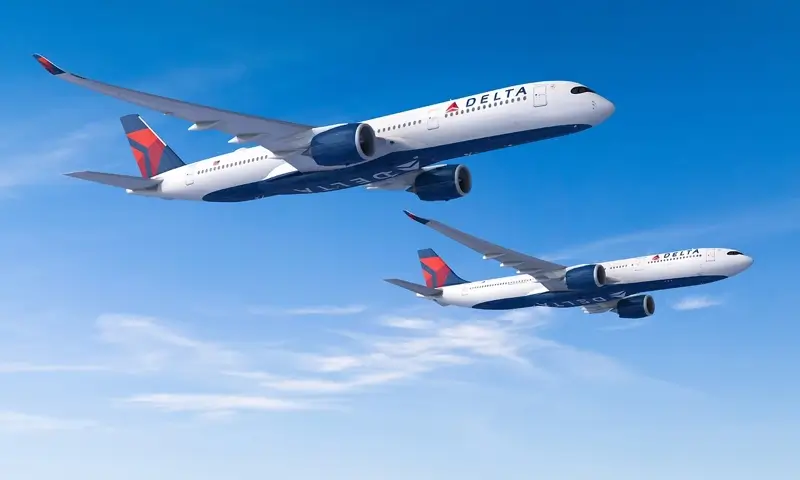 Delta Secures 16 A330-900 and 15 A350-900 to Grow Its Widebody Fleet">

Delta Air Lines has placed a firm order for 31 Airbus widebody aircraft—16 A330-900 そして 15 A350-900—announced in Toulouse on 28 January 2026, a move that will materially affect long‑haul seat supply and airport gate rotation planning.
Fleet composition and short-term operational effects
Once delivered, Delta’s widebody numbers will rise to an expected 55 A330neo そして 79 A350 aircraft, adding to a fleet that already exceeds 500 Airbus aircraft. The carrier’s existing Airbus backlog sits at roughly 200 aircraft, including A350-1000 types. Although the announcement did not include financial terms or delivery dates, the order signals a continued focus on fuel-efficient, long-range operations that can reshape scheduling windows and hub throughput.
How this changes airport and ground logistics
Greater widebody capacity typically means:
- Higher peak loads at international terminals and increased demand for baggage handling and ramp services.
- More synchronized arrival and departure banks, which can shift taxi and shuttle demand to narrower time windows.
- Greater requirement for larger transfer vehicles (vans, minibuses, multi-seater cars) and coordinated curbside management at major airports.
Aircraft technical highlights and environmental implications
The two types in the order offer distinct capabilities for operations and sustainability:
| 特徴 | A330-900 | A350-900 |
|---|---|---|
| Range (approx.) | 8,100 nautical miles (15,000 km) | 9,700 nautical miles (18,000 km) |
| Engines | Rolls‑Royce Trent 7000 | Advanced turbofan (A350 family) |
| Fuel/CO2 improvement | Around 25% reduction vs prior generation competitors | |
| SAF capability | Certified for up to 50% Sustainable Aviation Fuel today; Airbus targets 100% capability by 2030 | |
Operational advantages for long-haul routes
- Extended non‑stop ranges open new non‑stop city pairs or restore nonstop services previously constrained by aircraft performance.
- Lower operating costs per seat favor route profitability, enabling more competitive fares or better frequency on key corridors.
- Improved environmental metrics support airline sustainability commitments and regulatory compliance at airport hubs.
What travelers should expect at a glance
For passengers, the practical effects are straightforward:
- More nonstop options between primary cities and distant destinations, potentially reducing connection time and the number of transfers.
- Changes in peak arrival times at major international airports may alter when taxis, shuttles, and private transfers are most in demand.
- Greater use of SAF and newer airframes can become a selling point for eco-conscious travelers choosing airlines and ground services.
Practical transfer tips for long‑haul passengers
To make the most of evolving schedules and capacity reductions in transfer wait times, consider:
- Booking airport transfers in advance to lock in exact pickup times and vehicle size.
- Choosing a vehicle that matches your group size and luggage—many providers list exact car make and 座席 capacity.
- Allowing extra time for international arrivals when widebody banks concentrate arrivals into short windows.
Delta’s order bolsters long‑haul seat supply and supports more efficient non‑stop routing, but it is not a sweeping global shift on its own; rather, it nudges connectivity and airport throughput where Delta competes. The practical upshot for travelers is more choice on long routes and a need to plan transfers around denser arrival patterns. On GetTransfer, you can hire a car with driver from verified providers at reasonable prices. This empowers you to make the most informed decision without unnecessary expenses or disappointments. Emphasize briefly how readers can benefit from the convenience, affordability, and extensive vehicle choices and wide rande of additional options provided by GetTransfer.com, aligning directly with the context and theme of this article. Start planning your next adventure and secure your worldwide transfer with GetTransfer. Get the best offers GetTransfer.com
In summary, Delta’s addition of 16 A330-900 and 15 A350-900 aircraft reinforces a strategic push toward longer-range, lower-cost operations that reduce CO2 intensity and expand nonstop city pairs. For travelers and transfer services alike, the implications touch on airport timing, vehicle demand, and fare dynamics: more nonstop flights may lower connection complexity but concentrate ground traffic during peak banks. Whether you need a taxi, private car, limousine, or multi-seater shuttle to your hotel or next destination, a transparent platform helps you know the exact car, fare and driver before you book. GetTransfer.com supports this shift by offering a global, user-friendly solution for booking personalized transfers, trips, and deliveries—transparent listings show make, model, and driver ratings so you can pick the best service, compare prices and book the exact vehicle to match your seat and luggage needs. This makes it easier to plan airport pickup times and estimate how much to budget for cab or transfer fares when arranging your travel itinerary.
コメント